
"Wet room" gets used loosely in Dubai renovation conversations to mean any open, glass-fronted walk-in shower — but a true wet room is a specific construction method, not just a look. Understanding the actual difference matters, because it changes your waterproofing scope, your budget, and how forgiving the room will be if something goes wrong ten years from now.
What actually separates the two
A traditional shower enclosure contains water within a shower tray (or a raised, tanked shower base) and glass panels or a door, so only that contained footprint needs to be waterproofed to shower-specific standards — the rest of the bathroom floor is a "dry" zone in construction terms. A wet room has no tray and often minimal or no glass at all; the entire bathroom floor is waterproofed and gently graded toward a drain, so water is free to spread across the whole room during use and simply drains away.
| Factor | Wet Room | Shower Enclosure |
|---|---|---|
| Waterproofing scope | Entire bathroom floor + lower walls | Tray/base area + immediate surround only |
| Typical cost (Dubai) | AED 35,000 – 70,000+ | AED 15,000 – 35,000 |
| Floor build-up | Requires graded fall to drain, often raises or lowers slab | Standard flat floor, tray sits on top |
| Accessibility | Excellent — no threshold or step | Low-threshold trays available, but a lip usually remains |
| Visual/resale appeal | Reads as high-end, spa-like | Familiar, broadly appealing to all buyer types |
| Maintenance | Fewer grout lines/seals to fail over time if detailed well | Tray-to-wall seal needs periodic re-sealing |
| Best suited for | Primary ensuite, accessible/ageing-in-place bathrooms | Family bathrooms, budget-conscious renovations |
Why wet rooms cost more
The price gap isn't about the tap fittings or the tile — it's almost entirely about the floor. Achieving a proper fall toward a drain across an entire room, rather than just a shower tray, usually means either building up a screed floor with a graded slope or, in some cases, lowering part of the slab to accommodate it. This is genuinely structural work in a way that fitting a shower tray isn't, which is why wet room conversions typically run noticeably higher than an equivalent shower enclosure. It's a cost worth understanding before you fall in love with the look — our cost calculator can help you model both options against your actual bathroom footprint.
⚠ A wet room is only as good as its waterproofing
Because a wet room has no tray to contain water, a single weak point in the tanking membrane — around a drain, a pipe penetration, or a wall junction — can let water track into the subfloor or the ceiling below, with no visible sign until real damage has already occurred. This isn't a place to save money on materials or skip a step. See our full guide to bathroom ventilation and waterproofing for what a properly tanked wet room actually requires.
Accessibility and long-term living
One of the strongest arguments for a wet room isn't aesthetic — it's practical. A true wet room has no threshold or step to trip over, which makes it a genuinely good choice for a primary ensuite in a villa you intend to live in for decades, or for any household planning ahead for ageing in place or reduced mobility. Shower enclosures have improved on this front too, with low-threshold and level-access trays now widely available, but a small lip or transition strip usually remains.
Which one for which bathroom?
In practice, most of our clients choose a wet room for the primary ensuite — where it reads as a considered, high-end feature, ties in well with a double vanity layout, and gets the daily use that justifies the investment — and a well-detailed shower enclosure for family or guest bathrooms, where budget efficiency and familiarity matter more. This mirrors the broader thinking in our guide to ensuite vs family bathroom renovation priorities.
A real example
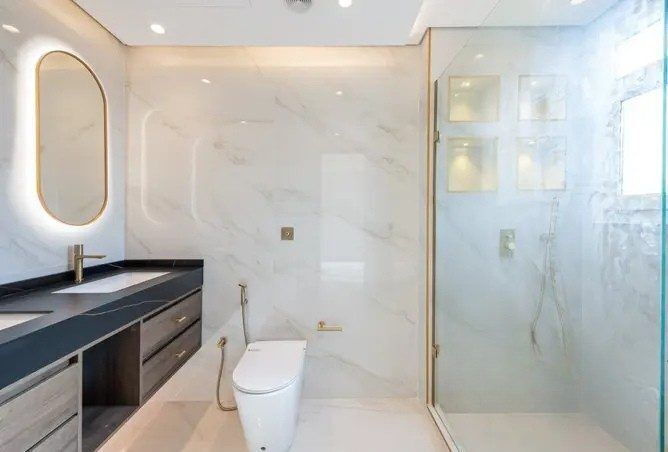
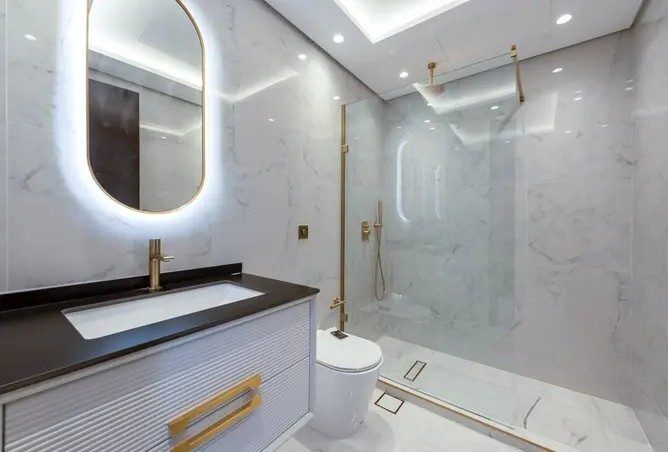
In our Palmera 4 renovation, the bathroom renovation combined a fully tanked walk-in shower area with minimal glass and a level floor transition, giving the open, spa-like feel of a wet room while keeping the detailing practical for daily family use — a good illustration of how the two approaches can blend rather than being a strict either/or choice.
Deciding Between a Wet Room and a Shower Enclosure?
We'll assess your bathroom's floor build-up and drainage options and give you a real cost for each before you decide.
Explore Bathroom RenovationFrequently asked questions
Is a wet room more expensive than a shower enclosure?
Yes, typically. A wet room requires full-room tanking, a formed floor gradient to a linear or point drain, and usually a lowered slab or built-up floor to achieve the fall — pushing costs to roughly AED 35,000-70,000+ versus AED 15,000-35,000 for a well-built shower enclosure with a tray.
Are wet rooms harder to waterproof than shower enclosures?
A wet room waterproofs the entire bathroom floor and lower walls since there's no shower tray or glass containing the water. A shower enclosure only needs the tray and immediate surrounding area tanked. This makes wet rooms more waterproofing-critical, not less — a single weak point in a much larger tanked area.
Do wet rooms sell better than shower enclosures in Dubai villas?
Wet rooms are increasingly popular in premium ensuite renovations and read as a luxury, spa-like feature to buyers. However, for a family bathroom used by children, a shower enclosure with a tray (and ideally a bathtub nearby) is usually the more broadly appealing and practical choice.