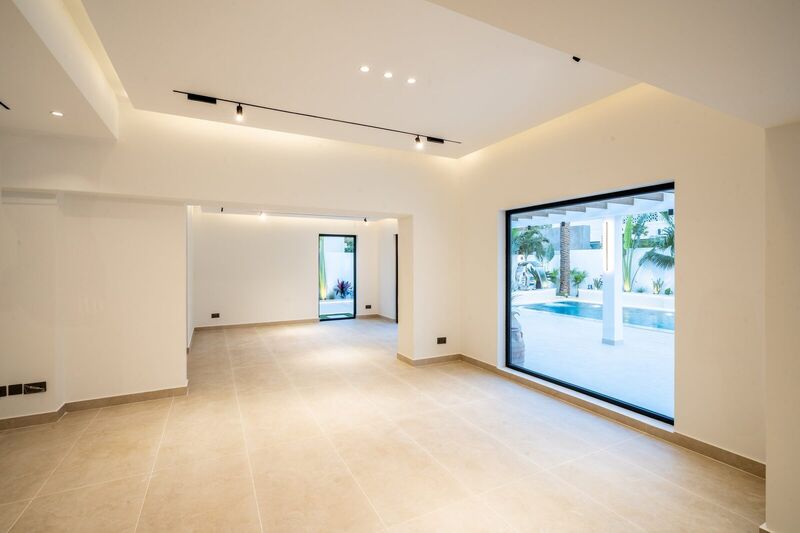

A home gym is one of the more popular spare-room conversions we're asked about in villas across Arabian Ranches, The Meadows and Dubai Hills Estate — and it's also one where a purely decorative approach (nice flooring, a big mirror, good lighting) can leave you with a room that looks the part but is uncomfortable to actually train in for more than twenty minutes.
The three functional decisions below matter more than any equipment choice, because they're expensive to change later and directly affect whether the room gets used.
Flooring: built for impact, not just looks
Standard villa flooring — porcelain, marble, engineered timber — isn't designed for dropped weights, repeated impact, or the point loads of a squat rack. Interlocking rubber tiles or rolled rubber flooring are the practical standard:
- 8-10mm rubber: suitable for cardio equipment and bodyweight/light dumbbell work.
- 15-20mm rubber: needed under any area where weights will be dropped or where a squat rack/platform will sit — this thickness genuinely protects both your subfloor and the equipment.
On upper floors, add a thin acoustic underlay beneath the rubber to reduce structure-borne impact noise transmitted to the room below — a detail that matters a lot in two-storey villas and is far easier to include during a renovation than after.
Mirrors: full sheets, not tiled panels
For anyone using the room to check form during lifts, mirror continuity matters. Tiled mirror sections with visible seams distort reflections at the joins, which is a real problem when you're checking bar or joint alignment mid-set. A single full-height mirror sheet (or as close to it as the room allows, typically around 2.4m tall) with safety backing film is the better investment, positioned on the wall you'll be facing during your main lifts — usually the long wall, not a side wall.
💡 Ventilation is the detail that determines whether the room gets used
A fully enclosed home gym with only the villa's standard AC vent will feel stuffy within 15-20 minutes of real exertion. The fix is a dedicated extraction fan or a boosted supply duct sized specifically for the room, separate from the general zone — this is an MEP decision that should be made before finishes go in, not retrofitted once the mirrors are up.
Sizing the room
| Setup | Minimum Size |
|---|---|
| Cardio + light free weights | 12 – 15 sqm |
| Multi-station (rack, bench, cardio) | 20 – 25 sqm |
| Full home gym with functional training zone | 28 sqm+ |
Whatever the total area, keep at least 1m of clear space around any rack or bench for safe movement and spotting — a common mistake is buying equipment first and fitting it into whatever space is left, rather than planning clearances from the room dimensions.
Power and cooling
Treadmills and some cable machines need a dedicated circuit rather than sharing a general-purpose outlet, particularly for motorised equipment. If the room will also host a wall-mounted screen or sound system, plan the outlet and data points during the same electrical first-fix as the ventilation work — running this later means chasing into finished walls.
What it costs
A home gym renovation (flooring, mirrors, lighting, ventilation and electrical — excluding equipment) typically runs AED 40,000 to 150,000 depending on room size and finish level. Equipment is a separate budget line and varies enormously based on brand and specification.
If you're deciding between a home gym and a home theatre conversion for the same spare room, ventilation and floor loading are usually the deciding factors — a gym needs far more airflow, while a theatre needs far more acoustic isolation and cabling.
Planning a Wellness Room or Spare Room Conversion?
Our MEP upgrades service handles the ventilation and electrical work a home gym depends on. Get a project estimate with our Renovation Cost Calculator.
Talk to Our TeamFrequently asked questions
What is the best flooring for a home gym?
Interlocking rubber tiles (8-20mm) or rolled rubber flooring are the standard choice. Thicker 15-20mm rubber is worth it in any area used for dropped free weights, since it absorbs impact and protects both the equipment and the subfloor below.
How big should a home gym be?
A basic cardio-and-free-weight setup needs 12-15 sqm. For a multi-station gym with a rack, bench and cardio equipment, plan for 20-25 sqm to keep clear space around each station for safe movement.
Why does a home gym need dedicated ventilation?
A home gym generates far more heat, humidity and CO2 per person than a typical room because of sustained physical exertion. Standard villa AC ducting is rarely sized for this, so a dedicated extraction fan or boosted duct run — separate from the main zone — is needed to keep the room comfortable and prevent mirror fogging and mould.