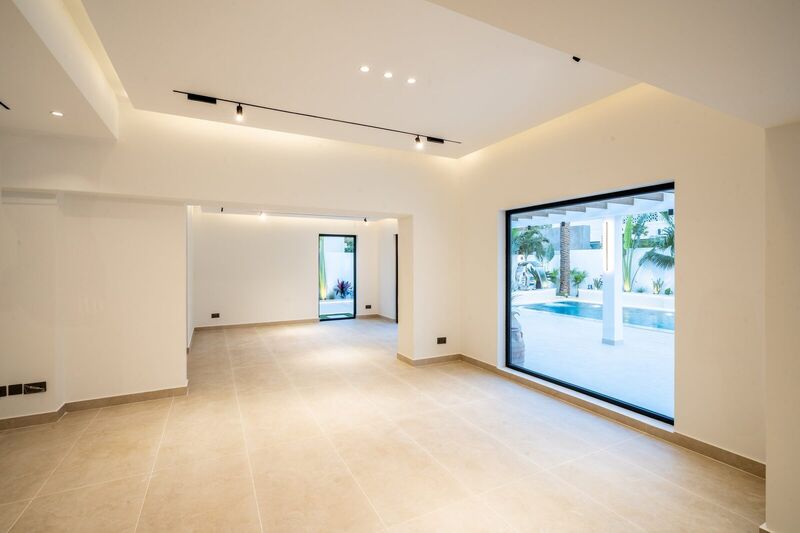

Wine cellars and dedicated wine rooms have become a fairly regular request in villa renovations across Emirates Hills, Al Barari and Arabian Ranches, typically as a conversion of an existing storage room, basement space, or under-stair void. The design brief is usually straightforward in principle — protect and display a collection — but the execution depends on getting a handful of technical factors right, above and beyond how the room looks.
Climate control is the whole point
Wine stored at the wrong temperature or humidity degrades, regardless of how good the racking or lighting looks. The standard target range is:
- Temperature: 12-14°C, held as stable as possible — fluctuation matters more than a slightly imperfect setpoint.
- Humidity: 50-70% relative humidity, to keep corks from drying out (too low) or mould developing on labels (too high).
A standard villa AC zone cannot reliably hold this range — it cycles on and off in ways that create temperature swings, and it doesn't manage humidity independently. A dedicated wine conditioning unit, sized to the room's volume and insulation level, is the correct equipment for this, not a repurposed split AC unit.
💡 Insulation determines how hard the conditioning unit has to work
Before selecting equipment, the room needs a proper vapour barrier and insulated walls, ceiling and door. A well-insulated room needs a smaller, quieter conditioning unit and holds its climate more consistently through power interruptions or door openings — this is worth prioritising over racking finishes if the budget is tight.
Location within the villa
Interior rooms away from exterior walls, direct sunlight, and heat-generating spaces (garages, plant rooms, kitchens) make the best wine rooms, since they start with a lower and more stable ambient temperature before conditioning is even applied. Under-stair spaces and interior storage rooms in Meadows and Arabian Ranches villas are commonly repurposed for exactly this reason — they're naturally insulated by surrounding rooms.
Racking, lighting and layout
- Racking material: timber (mahogany or redwood are traditional choices) gives a warmer, classic look; metal racking is more space-efficient and suits a more contemporary design. Both are functionally sound if properly installed.
- Display vs bulk storage: a mix works well in most residential wine rooms — a portion of label-forward display racking near the entrance, with denser bulk storage racking for the working collection.
- Lighting: low-UV LED fixtures only. Halogen lighting generates heat inside an enclosed, climate-controlled room, working directly against the conditioning system, and UV exposure degrades wine over time.
- Door: a sealed door — glass with a thermal break or a solid insulated door — is essential to prevent conditioned air escaping every time the room is accessed.
Sizing and capacity
| Room Type | Typical Size | Approx. Capacity |
|---|---|---|
| Tasting nook / display wall | 4 – 6 sqm | 150 – 300 bottles |
| Full wine cellar | 10 – 15 sqm | 600 – 1,500 bottles |
As a rough planning figure, wall racking holds approximately 40-60 bottles per sqm of wall area, depending on the racking system chosen.
What it costs
A wine room renovation typically costs AED 70,000 to 350,000+, with the range driven mainly by insulation quality, the conditioning system specification, and racking material — not by room size alone. A small, well-insulated tasting nook can cost more per bottle stored than a larger cellar with a basic build-out, because the climate control equipment is a relatively fixed cost regardless of scale.
A wine room often pairs well with a nearby home theatre or entertaining space, since both are typically windowless, climate-controlled rooms suited to interior parts of the villa.
Considering a Wine Room Conversion?
Our MEP upgrades service covers the specialised climate control a wine room depends on. Get a project estimate with our Renovation Cost Calculator.
Talk to Our TeamFrequently asked questions
What temperature and humidity should a wine cellar be kept at?
The standard target is 12-14°C with 50-70% relative humidity, held as stable as possible. Temperature swings are more damaging to wine over time than a slightly imperfect but stable setpoint, which is why a dedicated wine conditioning unit is used rather than standard villa AC.
Why can't I just use my villa's normal AC to cool a wine room?
Standard villa AC systems cycle on and off in ways that cause temperature and humidity swings unsuitable for long-term wine storage, and they don't manage humidity independently of temperature. A dedicated wine conditioning unit maintains both within a narrow, stable range and produces less vibration, which also matters for wine stored long-term.
How many bottles fit in a small wine room?
As a rough guide, wall racking holds approximately 40-60 bottles per square metre of wall, depending on the racking system. A compact 4-6 sqm tasting nook typically holds 150-300 bottles, while a full 10-15 sqm wine cellar can hold 600-1,500 bottles.